
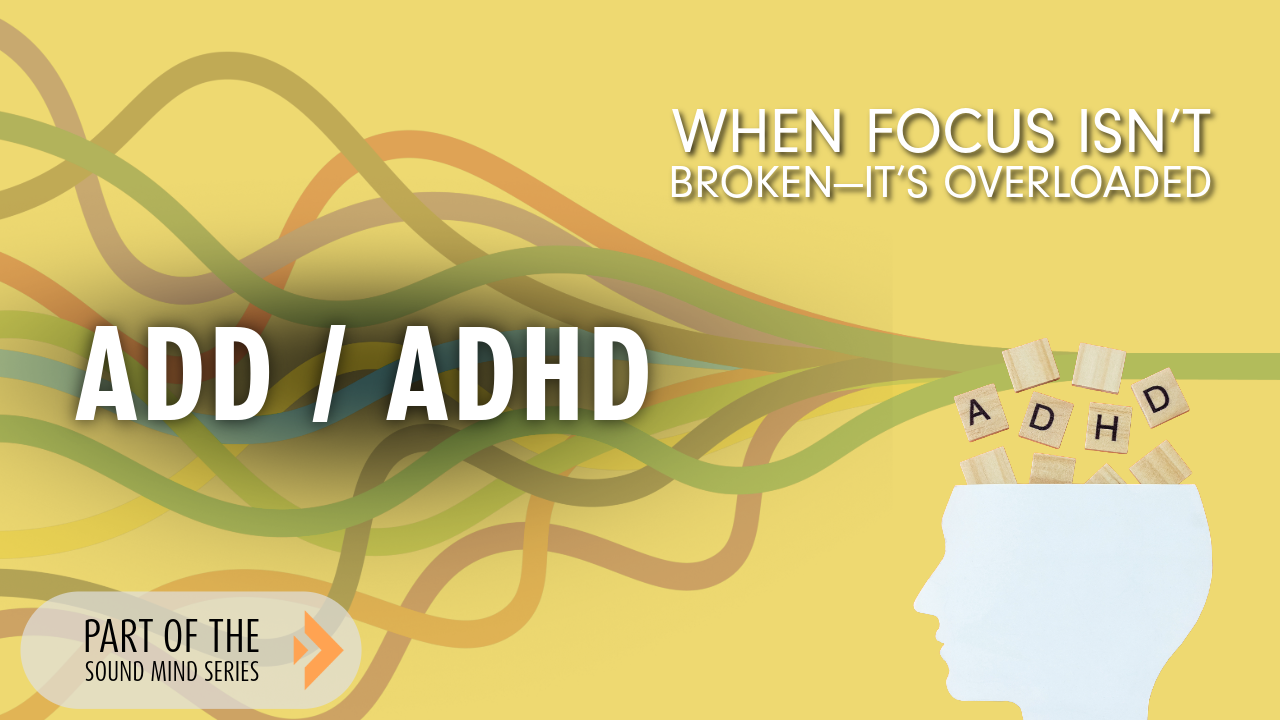
ADD / ADHD: When Focus Isn’t Broken—It’s Overloaded
Jan 21, 2026Part of The Sound Mind Series — exploring mental health through nutrition, biology, and faith.
As a counselor, coach, and pastor-at-heart, I’ve sat with countless individuals and families who feel discouraged, confused, or even ashamed by labels like ADD or ADHD.
Many of them have been told—directly or indirectly—that something is wrong with them.
But what if we’ve been asking the wrong question?
What if the issue isn’t a lack of attention at all… but too much attention happening at once?
Reframing ADD / ADHD Without Shame
The phrase attention deficit implies that something is missing—as if the brain simply doesn’t have enough focus, discipline, or willpower.
But in real life, many people with ADD or ADHD experience the opposite. Their minds are active, creative, observant, intuitive, and fast.
The challenge isn’t thinking.
The challenge is settling the thinking.
A more accurate picture for many people looks like this:
Too many mental windows open at the same time.
Thoughts, images, memories, emotions, ideas, tasks, and sensory input are all competing for space. The brain isn’t broken—it’s busy.
You might recognize it in phrases like:
- “My mind won’t shut off.”
- “I’m thinking about everything at once.”
- “I feel mentally loud.”
- “I can focus… just not on one thing for very long.”
That doesn’t sound like a deficit.
It sounds like overload.
Thought Creation vs. Thought Clearing
One helpful way to understand this is to look at two core functions of the mind:
- Thought creation – generating ideas, connections, images, plans, and associations
- Thought clearing – breaking down, resolving, and metabolizing those thoughts so the mind can return to calm
When thought creation outpaces thought clearing, the result isn’t productivity—it’s congestion.
This often shows up as:
- mental fog
- restlessness
- impulsivity
- scattered attention
- difficulty completing tasks
- emotional reactivity
In other words, the mind is producing faster than the system can process.
Why “Just Try Harder” Rarely Helps
Most people with ADD or ADHD have spent years trying to compensate by pushing harder—more effort, more pressure, more self-criticism.
But trying harder doesn’t quiet a busy mind.
Instead of asking, “How do I force myself to focus better?” a more helpful question is:
“What would help my mind slow down and clear?”
That shift changes everything.
The goal isn’t to overpower the nervous system. It’s to support it.
Medication can be helpful for some people, and this isn’t a dismissal of treatment. But it is an invitation to look deeper before assuming the only solution is long-term symptom management.
Sometimes the brain isn’t malfunctioning—it’s under-supported.
Quieting the Mind Starts With Foundations
When attention struggles are rooted in overload rather than deficiency, the path forward becomes clearer.
The focus shifts toward:
- reducing internal noise
- stabilizing the nervous system
- supporting healthy neurotransmitter balance
- creating daily rhythms that allow the mind to settle
This is where nutrition becomes more than a lifestyle suggestion—it becomes neurological support.
From both clinical experience and emerging genetic research, we are learning that many attention-related struggles are not primarily behavioral. They are biological bottlenecks—places where the brain is trying to function without the raw materials it needs.
Why Nutrition Matters for Focus and Mental Clarity
The brain is not just an idea-producing organ. It is a chemically active system that depends on constant input:
- Neurotransmitters like dopamine and serotonin must be made, used, and cleared.
- That process requires amino acids, vitamins, minerals, and proper metabolic pathways.
- When those pathways are inefficient—or genetically impaired—the mind often feels noisy, scattered, or overstimulated.
In emerging genetic research, the challenge is often not intelligence or motivation. It is conversion—the body’s ability to take in nutrients and refine them into forms the brain can actually use.
The body may have access to nutrients, but it struggles to convert them into the usable forms the brain relies on.
When methylation is sluggish or impaired:
- neurotransmitters linger longer than they should
- thought-clearing slows down
- mental stimulation accumulates instead of resolving
This is one reason some people feel wired but tired, mentally busy but emotionally flat, or overstimulated yet unfocused.
Blood Sugar, Protein, and the Overloaded Brain
Another often-overlooked factor is blood sugar stability.
Rapid spikes and crashes—especially common with high-sugar, low-protein diets—can mimic or worsen symptoms of ADD/ADHD:
- restlessness
- irritability
- impulsivity
- difficulty sustaining focus
The brain runs heavily on glucose, but it functions best when that fuel is delivered steadily, supported by adequate protein and healthy fats. Without that stability, the nervous system stays on high alert.
This Is Not About Perfection
This conversation is not about rigid diets or nutritional guilt.
It’s about asking a compassionate question:
Does my brain have the raw materials it needs to do what I’m asking it to do?
For many people, even small shifts—adequate protein, proper forms of B vitamins, consistent meals, hydration, and sleep—create noticeable changes in mental clarity and emotional regulation.
This isn’t about fixing something broken.
It’s about supporting something under-resourced.
And when the body is supported, the mind often follows.
Clinical & Educational Note
This article is educational in nature and reflects a holistic, integrative perspective. It is not intended to diagnose or replace individualized medical or mental health care. If you are currently taking medication or managing a diagnosed condition, any changes should be discussed with a qualified healthcare professional.
A Faith-Centered Perspective on a Busy Mind
From a Christian perspective, this reframe matters.
A scattered or overactive mind does not mean you are broken.
It does not mean you lack discipline or spiritual maturity.
And it does not mean you are failing God.
It may simply mean your body and brain are asking for care.
Scripture reminds us:
For God has not given us a spirit of fear, but of power and of love and of a sound mind.
— 2 Timothy 1:7 (NKJV)
A sound mind isn’t frantic.
It isn’t overloaded.
It is a mind supported by wisdom, peace, and intentional stewardship of the whole person—mind, body, and spirit.
A Gentle Place to Begin
If this description resonates with you, start here—not with shame, but with curiosity:
- When does your mind feel the most overloaded?
- What environments or habits seem to amplify the noise?
- What rhythms—sleep, nourishment, movement, stillness—help your mind feel calmer?
Small, consistent changes to foundations often bring more clarity than sheer willpower ever could.
In future posts, we’ll continue exploring how mood, focus, and emotional resilience are deeply connected to what’s happening in the body—especially through nutrition, the gut–brain connection, and the way our brains are chemically supported.
Closing Prayer
Lord, thank You for creating my mind with intention and purpose. When my thoughts feel crowded and my focus feels scattered, help me respond with grace instead of frustration. Give me wisdom to care for my body, patience with myself in the process, and peace that quiets my mind. Teach me how to steward what You’ve entrusted to me—mind, body, and spirit. In Jesus’ name, amen.